
Before an international trip, most travelers remember passports, flights, and hotel bookings. However, one small detail can quickly become a frustrating problem after landing: your charger does not fit the wall outlet.
Whether you are traveling from the US to Europe, working remotely across Asia, studying abroad, or taking a multi-country vacation, understanding international plug types helps you avoid unexpected charging issues.
Different countries use different outlet designs, plug shapes, and electrical standards. A charger that works perfectly at home may not physically connect to a socket overseas, even if the device itself supports international voltage.
Quick answer: The most common international plug types are Type A, B, C, G, and I. Type A and B are mainly used in North America, Type C is widely used throughout Europe, Type G is common in the UK and several Asian regions, and Type I is used in Australia, New Zealand, and China.
This guide explains the most common power outlet types worldwide, where they are used, and what travelers should know before connecting their devices abroad.
Why Are There Different International Plug Types?
Countries around the world developed their electrical systems independently, which resulted in different plug designs and outlet standards.
The differences between plug types are mainly related to:
- Physical plug shape
- Number and arrangement of pins
- Grounding methods
- Local electrical safety standards
For example, travelers from the United States are familiar with Type A and Type B outlets, while visitors to the United Kingdom will encounter Type G sockets with three rectangular pins.
These differences do not mean one system is better than another. They simply reflect how electrical infrastructure evolved in different regions.
According to the International Electrotechnical Commission (IEC), international electrical standards help improve safety, compatibility, and reliability across electrical systems worldwide.
International Plug Types by Country: Quick Travel Reference
The easiest way to prepare for international travel is to check the plug type used at your destination.
| Country / Region | Common Plug Type | Voltage | Adapter Usually Needed? |
|---|---|---|---|
| United States | Type A / B | 120V | Depends on destination |
| Canada | Type A / B | 120V | Depends on destination |
| United Kingdom | Type G | 230V | Usually yes |
| Ireland | Type G | 230V | Usually yes |
| France | Type C / E | 230V | Usually yes |
| Germany | Type C / F | 230V | Usually yes |
| Italy | Type C / F / L | 230V | Usually yes |
| Spain | Type C / F | 230V | Usually yes |
| Japan | Type A / B | 100V | Sometimes |
| China | Type A / C / I | 220V | Usually yes |
| Australia | Type I | 230V | Usually yes |
| New Zealand | Type I | 230V | Usually yes |
| Singapore | Type G | 230V | Usually yes |
| Hong Kong | Type G | 220V | Usually yes |
| India | Type C / D / M | 230V | Usually yes |
| South Korea | Type C / F | 220V | Usually yes |
Because plug standards can vary even between nearby countries, checking your exact destination is always recommended.
Common International Plug Types Explained
Type A Plug: North American Flat Two-Pin Plug
Type A is one of the most widely recognized plug designs.
It features:
- Two flat parallel pins
- No grounding pin
- Compact design
Common locations include:
- United States
- Canada
- Japan
- Mexico
- Taiwan
Many travelers from North America are familiar with Type A outlets. However, this plug shape may not fit sockets in Europe, the UK, or Australia.
Type B Plug: Flat Pins With Grounding
Type B looks similar to Type A but includes an additional grounding pin.
It features:
- Two flat parallel pins
- One round grounding pin
Common locations include:
- United States
- Canada
- Mexico
- Japan
The grounding design makes Type B suitable for devices that require additional electrical protection.
Type C Plug: The European Two-Round-Pin Plug
Type C is one of the most common international plug types used by travelers.
It features:
- Two round pins
- Compact design
- No grounding pin
Common countries include:
- France
- Germany
- Italy
- Spain
- Netherlands
- Greece
Because Type C is widely used across Europe, many travelers encounter it during European trips.
However, Europe does not have one universal plug standard. Some countries use Type E or Type F variations, so checking your destination remains important.
Type G Plug: The United Kingdom Plug
Type G is one of the easiest plug designs to identify.
It features:
- Three rectangular pins
- Grounding connection
- Safety shutter design
Common locations include:
- United Kingdom
- Ireland
- Hong Kong
- Singapore
- Malaysia
Travelers visiting these destinations usually need a compatible adapter because Type G outlets are very different from North American and European designs.
Type I Plug: Australia, New Zealand, and China Plug
Type I uses an angled pin design.
It features:
- Two flat angled pins
- Optional grounding pin
Common locations include:
- Australia
- New Zealand
- China
- Argentina
Although some countries share the same plug design, voltage requirements may still differ.
Other Plug Types Around the World
Some destinations use less common plug standards.
Type D
Common in:
- India
- Nepal
- Sri Lanka
Features:
- Three round pins
- Often found in older electrical systems
Type E
Common in:
- France
- Belgium
- Poland
Features:
- Two round pins
- Grounding connection
Type F (Schuko)
Common in:
- Germany
- Austria
- Spain
- Portugal
Features:
- Two round pins
- Side grounding contacts
Type J and Type K
Used mainly in:
- Switzerland
- Denmark
Most international travelers will mainly encounter Type A, B, C, G, and I.
Plug Type vs Voltage: What Travelers Need to Understand
One of the biggest misunderstandings about international charging is confusing plug compatibility with voltage compatibility.
They are related, but they are not the same.
Plug Type: Will It Fit?
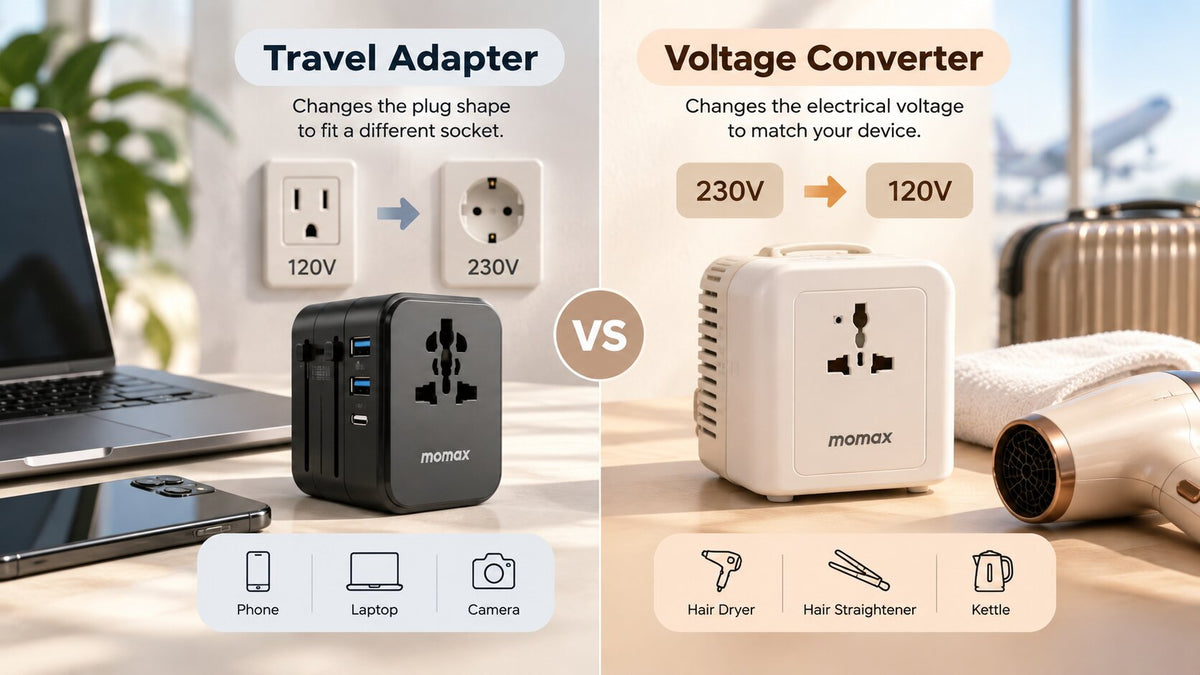
A plug adapter changes the physical connection between your charger and the wall outlet.
For example:
- A US charger may need an adapter to connect to a UK Type G socket.
- A European charger may need an adapter when visiting Australia.
Voltage: Will It Work Safely?
Voltage determines whether your device can operate safely.
Common voltage systems include:
- 100–120V
- 220–240V
Many modern electronics support worldwide voltage ranges.
Check your charger label. If you see:
Input: 100-240V
it usually means the device can work internationally with the correct plug connection.
Most:
- Smartphones
- Tablets
- Laptops
- Camera chargers
are designed for international use.
However, high-power appliances such as:
- Hair dryers
- Curling irons
- Electric heaters
may require additional voltage consideration.
For travelers who frequently move between countries, choosing the right travel adapter collection can simplify charging across different outlet standards.
Do You Need a Travel Adapter for International Travel?
Not every international traveler needs the same setup.
You may need an adapter when:
- Your charger plug does not match your destination outlet
- You are visiting multiple countries
- Your hotel does not provide universal charging outlets
- You carry several electronic devices
For example:
A traveler from the United States visiting France will likely need a Type C/E-compatible adapter.
A traveler from Europe visiting Japan may need a Type A/B-compatible adapter.
Frequent international travelers, business professionals, and digital nomads often carry multiple devices, including:
- Laptop
- Smartphone
- Tablet
- Camera
- Smartwatch
A reliable charging setup can make multi-country travel much easier.
How Different Travelers Should Prepare
Business Travelers
Business travelers often visit multiple destinations in a short period.
A monthly schedule might include:
- London (Type G)
- Singapore (Type G)
- Tokyo (Type A/B)
Checking plug compatibility before each trip prevents unnecessary interruptions.
Digital Nomads
Remote workers depend on reliable charging.
Their setup often includes:
- Laptop
- External accessories
- Phone
- Camera equipment
Understanding local outlet standards helps maintain productivity while working internationally.
Students Studying Abroad
Students staying overseas for months should consider:
- Dormitory outlet types
- Laptop charging needs
- Long-term device compatibility
Preparing before departure avoids needing emergency purchases after arrival.
Tips for Checking Plug Types Before Your Trip
1. Confirm Your Destination Plug Type
Search the electrical outlet standard for each country you visit.
For multi-country trips, check every destination separately.
2. Check Your Device Voltage
Look at your charger label before packing.
Most modern electronics support:
- 100–240V input
3. Count Your Devices
Modern travelers often carry several electronics.
Think about:
- How many devices need charging?
- Do you need USB charging?
- Will you work while traveling?
4. Prepare Before Departure
Before leaving:
- Confirm outlet type
- Pack necessary adapters
- Test chargers
- Check hotel information
Frequently Asked Questions About International Plug Types
What are the most common international plug types?
The most common international plug types are Type A, B, C, G, and I. Type A and B are common in North America, Type C is widely used in Europe, Type G is used in the UK and several Asian regions, and Type I is common in Australia and China.
What plug type does Europe use?
Europe mainly uses Type C, Type E, and Type F plugs. While many European countries share compatible two-round-pin designs, travelers should check their exact destination because standards can vary between countries.
What plug type does the USA use?
The United States mainly uses Type A and Type B plugs with a standard voltage of 120V. Travelers visiting the US from other regions may need an adapter depending on their charger design.
Do I need a universal adapter for international travel?
A universal adapter can be useful for travelers visiting multiple countries because plug designs vary worldwide. However, the right solution depends on your destinations and the devices you plan to charge.
Can I use my phone charger internationally?
Most modern phone chargers support international voltage ranges between 100V and 240V. You may only need a plug adapter if the physical plug shape does not match the outlet.
Is a plug adapter the same as a voltage converter?
No. A plug adapter changes the physical connection between the charger and outlet. A voltage converter changes electrical voltage. Most smartphones and laptops only require the correct plug connection, while some high-power appliances may require voltage conversion.
Final Thoughts: Know Your Plug Type Before You Travel
Understanding international plug types is a simple but important part of international travel preparation.
Before your next trip, check:
- Which plug type your destination uses
- Whether your devices support local voltage
- What charging setup fits your travel needs
From short vacations to long-term international work, knowing how global power outlets differ helps you stay connected wherever your journey takes you.