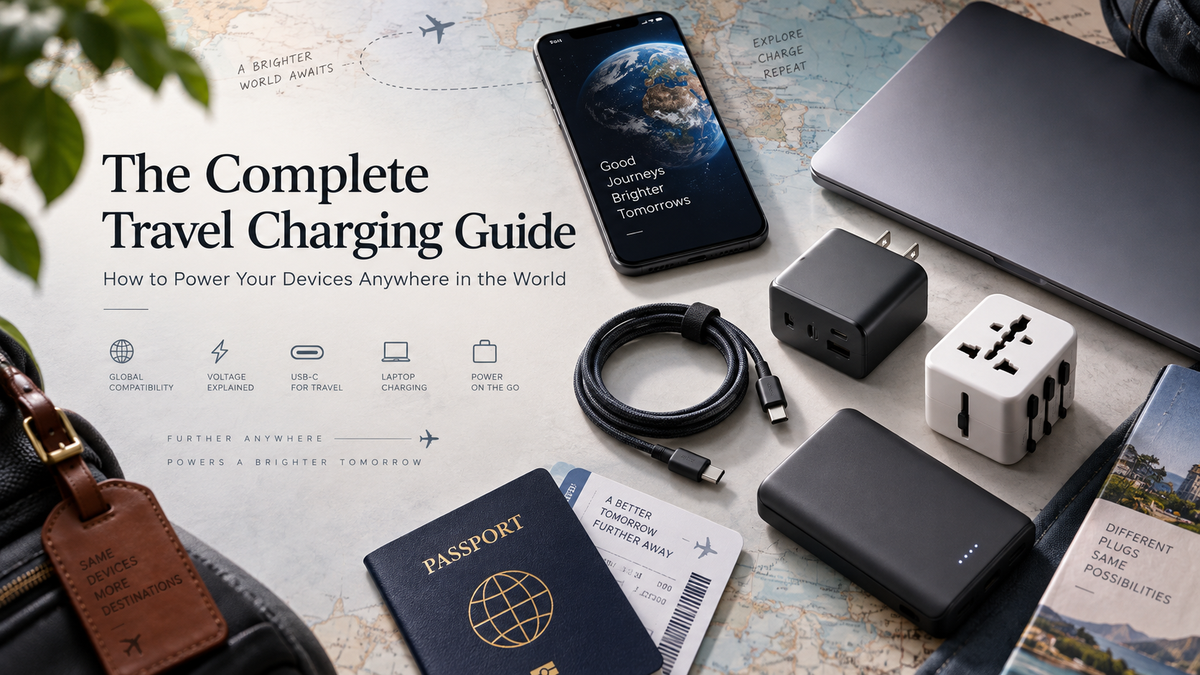

A travel adapter is a device that lets a plug designed for one type of wall socket connect to a different socket used in another country or region. It solves a physical plug mismatch. A standard travel adapter does not change the mains voltage supplied by the wall outlet.
That distinction is the key to understanding travel adapters.
When you take electronics abroad, there are usually two separate questions to consider: does the plug fit the socket, and can the device accept the local electrical supply? A travel adapter primarily addresses the first.
What Is a Travel Adapter?
A travel adapter, sometimes called a travel adaptor or plug adapter, creates a physical connection between your device's plug and a wall socket with a different shape.
For example, a charger with a US-style plug cannot be inserted directly into a UK Type G socket. A compatible adapter sits between the plug and the wall outlet so the two different formats can connect.
The adapter does not change your original plug permanently. Instead, it provides the appropriate physical interface while you are using the device abroad.
There is no single household plug and socket standard used worldwide. The International Electrotechnical Commission's IEC TR 60083 documents plug and socket-outlet systems used in IEC member countries, reflecting the variety of national systems travelers can encounter.
How Does a Travel Adapter Work?
A travel adapter works by connecting two plug formats that would otherwise be physically incompatible.
Think of the connection as:
Your device plug → travel adapter → destination wall socket
Suppose you travel from the United States to the United Kingdom with a phone charger that has flat US-style pins. The UK socket uses a different three-pin format, so the charger cannot be plugged in directly.
A suitable adapter provides the plug interface needed to connect the charger to that socket.
Electricity still comes from the local wall outlet. The adapter simply allows the physical connection to take place.
This is why a plug fitting successfully does not, by itself, confirm that an electrical device is suitable for the local voltage.
Why Are Electrical Plugs Different Around the World?
Modern plug differences are largely the result of electrical systems developing independently across countries and regions.
Instead of one worldwide standard being adopted from the beginning, different markets developed their own socket designs, plug shapes, grounding arrangements and electrical requirements.
That is why international travelers encounter several plug formats today.
Common examples include:
- Type A and Type B, commonly used in the United States and several other destinations
- Type G, used in the United Kingdom and various other countries and regions
- Type I, commonly associated with Australia and New Zealand
- Type C and related European plug systems, widely encountered across continental Europe
These categories describe physical plug and socket formats. The electrical supply behind the socket can also differ between destinations.
The IEC maintains technical information on national plug and socket-outlet systems, which is one reason checking your specific destination is more reliable than assuming an entire continent uses a single standard.
Why Do You Need a Travel Adapter When Traveling?
You need a travel adapter when the plug attached to your device or charger does not fit the wall socket at your destination.
This can affect many of the electronics people routinely carry, including phones, tablets, laptops, cameras and smartwatches.
Imagine that your laptop charger works perfectly at home. You arrive at your hotel abroad and discover that its plug cannot enter the wall socket. The laptop and charger may still be electrically suitable for use there, but the different plug shape prevents the connection.
That is the problem a travel adapter solves.
You do not automatically need one every time you cross an international border. If your plug already matches the socket used at your destination, a separate plug adapter may not be necessary.
The deciding factor is plug compatibility, not simply whether the trip is international.
Does a Travel Adapter Change Voltage?
No. A standard travel adapter changes the physical plug connection; it does not normally convert the mains voltage or frequency.
For example, connecting a device designed only for 120V to a higher-voltage electrical supply does not become safe simply because an adapter makes the plug fit.
Electrical Safety First's travel adaptor guidance makes this distinction explicitly: travel adaptors allow appliances to connect to foreign sockets, but they do not convert voltage or frequency.
A voltage converter serves a different purpose: it changes electrical voltage when conversion is required.
For most travelers, the useful distinction is simple:
A travel adapter helps the plug fit. Voltage compatibility determines whether the device can safely use the local electrical supply.
That is why both should be checked separately.
A Simple Example of Using a Travel Adapter Abroad
Suppose a traveler from the United States takes a phone charger to the UK.
The charger's label says:
Input: 100–240V, 50/60Hz
The charger itself uses a US-style plug, while the hotel room has a UK Type G socket.
In this situation, the charger label indicates that its power supply is designed to accept an input within the stated voltage and frequency range. The remaining problem is physical: the US plug does not fit the UK socket.
A compatible travel adapter provides that connection.
The adapter is not converting UK electricity into US electricity. The charger's own power supply is designed to operate within the range printed on its label.
This example illustrates the most useful rule to remember when traveling with electronics:
Electrical compatibility and plug compatibility are related, but they are not the same thing.
What Should You Check Before Plugging In Abroad?
Before connecting electronics in another country, check the destination's socket type and electrical supply rather than assuming your equipment will work because the plug can be made to fit.
A few basic checks cover most situations.
Check the Destination Plug Type
Find out which wall socket format is used where you are going.
This is especially important on trips involving several countries. Plug systems can differ from one destination to another, so a setup that works at one stop may not necessarily work at the next.
Check the Device's Input Voltage
Look at the label on the charger, power supply or electrical device.
Many modern electronic power supplies display information similar to:
Input: 100–240V, 50/60Hz
This means the power supply is designed to operate within the stated input range.
However, not every device supports a wide voltage range. Do not assume that a hair dryer, styling tool, shaver, charger or other appliance is dual voltage without checking its specifications.
Electrical Safety First notes that electricity supplies vary internationally and recommends checking the appliance's voltage requirements before plugging it in abroad.
Check the Adapter and Device Ratings
The adapter also has its own electrical limits.
Check its rated current or wattage and make sure the connected equipment does not exceed those limits. Electrical Safety First similarly recommends checking the maximum power rating shown on the adapter before use.
Grounding can matter as well. If a device requires an earth connection, use equipment suitable for that requirement.
And, as with any electrical accessory, do not use an adapter, plug or wall outlet that appears damaged, loose or overheated.
Can You Use a Phone or Laptop Charger Abroad?
Often, yes—but the answer depends on the specifications printed on the charger.
Many modern phone and laptop power supplies accept a broad input range such as 100–240V and 50/60Hz. When the destination's electrical supply falls within the charger's stated range, the remaining issue may simply be whether its plug fits the local socket.
That is where a travel adapter can be useful.
The safest approach is not to assume compatibility based on the type of device. Check the actual input specifications supplied by the manufacturer.
If the charger supports the local electrical supply but uses a different physical plug, an adapter addresses the plug mismatch.
If you are researching charging equipment itself rather than international plug compatibility, MOMAX's USB-C chargers and power adapters cover that separate charging category.
Understanding Travel Adapters Before Your Next Trip
A travel adapter has a straightforward job: it allows a plug made for one socket system to connect to a different type of wall socket.
It solves the physical compatibility problem.
It does not automatically solve differences in voltage or frequency. Before using electronics abroad, check both the destination's electrical system and the input specifications printed on your charger or device.
Once you separate those two questions—Will the plug fit? and Can the device use the local electricity?—travel adapters become much easier to understand.
If your destination uses a different plug system and you have already confirmed the electrical compatibility of your devices, you can explore MOMAX's travel adapters as a separate next step.
Frequently Asked Questions
What is a travel adapter used for?
A travel adapter allows a plug designed for one socket format to connect to a different wall socket. Travelers commonly use one when the plug on a charger or device does not physically match the socket available at their destination.
Can I use my phone charger in another country?
Possibly. Check the input voltage and frequency printed on the charger and compare them with the electrical supply at your destination. If the charger is electrically compatible but its plug does not fit the local socket, a travel adapter may provide the physical connection you need.
Do all countries use the same plug type?
No. Several plug and socket systems are used around the world. Some countries share compatible formats, while others use different designs. Check the plug type used at your specific destination before traveling.
Can I use a travel adapter with a dual-voltage device?
Yes, provided the adapter is compatible with the destination socket and suitable for the device's electrical requirements. A dual-voltage device may already support the local supply voltage, while the travel adapter solves the separate problem of getting its plug to fit the socket.