
Do you need a travel adapter when traveling abroad? Only if your charger's plug doesn't fit the outlets at your destination. If your plug already fits and your device supports the local electrical supply, you can usually leave the adapter at home.
The tricky part is knowing what you'll find when you arrive. A phone charger that works perfectly in Canada might be useless at a UK hotel without the right plug connection. Meanwhile, some hotels and airports offer USB charging that lets you skip the wall outlet altogether.
Before adding another accessory to your suitcase, here's how to decide whether you actually need one.
When Do You Need a Travel Adapter—and When Can You Skip It?
The easiest way to decide is to think about where you'll plug in your devices, not just which country you're visiting.
If your charger fits the available outlet and supports the local electricity supply, you generally don't need a travel adapter. If it doesn't fit, an adapter may be necessary—but only if your equipment is electrically compatible.
Here's how common situations compare:
| Your situation | Do you need a travel adapter? |
|---|---|
| Your plug fits the outlet and your device supports the local electrical supply | No |
| Your plug doesn't fit, but your device supports the local electrical supply | Yes, if using that wall outlet |
| You can charge directly through a suitable USB port | Not necessarily |
| Your device doesn't support the local voltage | An adapter alone isn't enough |
| You're relying on hotel or airport charging facilities | Check first |
Consider a simple example. You're traveling from the US to the UK with a phone charger. The charger can handle UK voltage, but its American plug doesn't fit a British wall socket. You need an adapter to make that connection.
Now imagine your hotel room has a suitable USB port. If you can charge your phone directly with its cable, you may not need the plug adapter after all.
That's why the answer isn't always a straightforward yes or no.
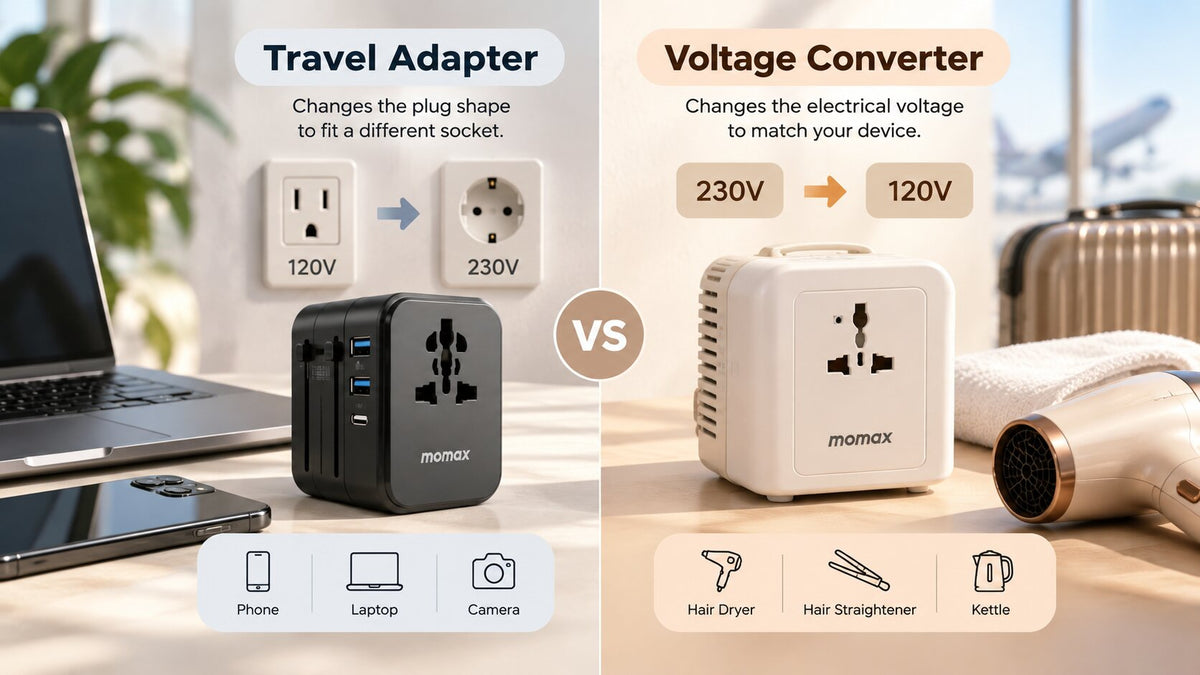
A travel adapter addresses a physical plug mismatch, but it doesn't normally change electrical voltage. If you're unfamiliar with the distinction, our explanation of how travel adapters work covers the fundamentals.
For the decision itself, start with your destination.
Do You Need an Adapter for Your Destination?
Different countries use different electrical outlets, but crossing a border doesn't automatically mean changing plugs.
For example, the United States and Canada commonly use the same Type A and B socket systems. A typical US charger will generally plug into Canadian outlets without an adapter.
Travel from the US to the UK, however, and you'll encounter the British Type G socket, which requires a different plug connection.
Here are six common travel scenarios:
| Traveling from → to | Adapter needed? | What to expect |
|---|---|---|
| US → Canada | Usually no | Both countries commonly use Type A and B outlets. |
| US → France | Yes | France uses Type C and E socket systems. |
| US → UK | Yes | British Type G outlets don't accept standard US plugs directly. |
| US → Japan | Depends | Two-pin Type A plugs generally fit, but grounded Type B outlets aren't available everywhere. |
| UK → Spain | Yes | Spain commonly uses Type C and F sockets rather than UK Type G. |
| US → Australia | Yes | Australian Type I outlets use a different pin arrangement. |
These comparisons assume travelers are bringing their usual domestic plugs. They describe physical plug compatibility, not whether the appliance supports the destination's voltage.
Japan is a useful example of why that distinction matters. A US two-pin charger may fit a Japanese outlet without an adapter, but Japan operates on a 100V supply rather than the 120V commonly used in the US. Your device still needs to support the local voltage and frequency.
For destinations beyond those listed here, check the country-by-country plug and voltage reference before traveling.
What if you're visiting multiple countries?
A trip through France, Spain, and Portugal may be easier to manage because these countries use common European plug systems.
However, not every European plug is interchangeable. Modern hybrid Type E/F plugs are designed to work with both E and F sockets, while certain older grounded plugs have compatibility limitations.
It's worth checking the specific plug you're carrying, particularly if your equipment requires grounding.
If your itinerary also includes the UK, you'll encounter a different socket standard.
The practical takeaway is to check your entire route. You may need one compatible adapter for several destinations, or different connections depending on where you're going.
Does Your Phone, Laptop, or Other Device Need an Adapter?
Your destination tells you which outlets to expect. Your devices determine whether those outlets will actually be a problem.
Someone traveling with only a smartphone may have more flexibility than a business traveler carrying a laptop or a family bringing several appliances.
If you're only bringing a smartphone
Having a USB-C phone doesn't automatically mean you can travel without an adapter.
USB-C is the connection between your phone and its charging cable or power source. It doesn't determine whether your wall charger fits a foreign socket.
If you're bringing a US wall charger to France, for example, you'll generally need a compatible adapter to use it in a standard French outlet.
But if your accommodation provides a suitable USB charging port, you may be able to connect your phone directly without using the wall charger.
The deciding factor is whether you have a compatible way to charge—not simply whether your phone uses USB-C.
If you're traveling with a laptop
Many modern laptop power supplies are designed for international electrical systems. Their input labels often show a range such as:
Input: 100–240V ~ 50/60Hz
If your charger has that rating, it generally supports mains supplies within those voltage and frequency ranges. You may only need to address the physical plug connection.
Still, check your actual charger rather than assuming every laptop power supply is identical.
If you're carrying several electronics, our travel charging guide covers the broader questions of charger output, cables, and charging multiple devices abroad.
If you're bringing hair dryers or styling tools
This is where checking voltage becomes particularly important.
Some hair dryers, straighteners, and curling irons are designed for a single voltage range. A device rated only for 120V cannot safely be used on a 230V supply simply by adding a plug adapter.
Even when an appliance supports the local voltage, its power requirements and grounding needs must be compatible with the outlet and adapter.
Electrical Safety First's international travel electrical safety advice recommends checking local voltage, frequency, and adapter suitability before connecting appliances abroad.
If a styling tool isn't compatible with your destination's electrical supply, using an appropriate locally compatible appliance may be the simpler option.
Can You Travel Without an Adapter if Hotels and Airports Have Charging Ports?
Possibly—and this is one of the most overlooked reasons you might not need to pack a separate adapter.
Travelers often check their destination's plug type but forget to consider where they'll actually charge their devices.
A hotel with suitable USB ports can change your plans. So can an airport with accessible charging stations. The catch is that these facilities vary considerably.
Hotels: convenient charging isn't guaranteed
Some hotels offer multi-standard outlets, USB-A or USB-C charging ports, or adapters available to borrow from reception.
Others have only the standard wall sockets used in that country.
Imagine two travelers visiting London.
One books a hotel with a suitable USB charging port beside the bed. They're carrying only a smartphone and can charge directly with their cable.
The other stays in an older guesthouse with conventional UK outlets and brings a US wall charger. That traveler will need a suitable adapter or another compatible charging source.
Same destination, different answer.
Before relying on your accommodation, check whether:
- The room has USB ports suitable for your devices.
- The wall outlets accept your charger's plug.
- The hotel offers adapters to borrow, and whether availability is guaranteed.
A quick message to your hotel can save you from packing unnecessary accessories—or arriving without a reliable way to charge.
Be careful with outlets described as "universal," too. A socket that physically accepts several plug shapes doesn't necessarily provide proper grounding for every device.
For longer stays, work trips, or family holidays where several devices need power, relying entirely on the hotel's facilities may be inconvenient.
Airports: useful for charging, but not a complete plan
Airports can make it easier to charge without a travel adapter, especially if you only need to top up your phone between flights.
Some provide USB charging points, while others offer conventional power sockets or dedicated charging stations.
London Heathrow Airport, for example, states that free Power Pole charging stations are available in all terminals, before and after security. According to Heathrow Airport's official charging information, these stations support UK and European plugs as well as USB cables.
That gives travelers another way to charge, even when their usual wall plug doesn't fit the local socket.
But availability doesn't guarantee convenience.
Charging points can be occupied, too far from your departure gate, or unsuitable for the equipment you're carrying. A USB connection that charges your phone may also lack the power required by your laptop.
Consider the rest of your journey as well. An airport charging station won't solve the problem of incompatible outlets at your final accommodation.
When can you reasonably skip the adapter?
If you're taking a short trip, carrying only a few USB-powered devices, and have confirmed suitable charging options at your accommodation, you may not need one.
If you're changing hotels, traveling through several countries, or need dependable charging for work and multiple devices, bringing your own compatible charging setup is usually more practical.
The difference comes down to how much you can rely on the facilities available during your trip.
Your Final Pre-Trip Adapter Checklist
Before you leave, take a few minutes to check the equipment you're bringing and the places you'll be staying.
- Check your destination's plug types. Look up the electrical sockets used in each country on your itinerary. Don't assume neighboring countries always use the same system.
- Compare your chargers' plugs. Check the actual pins on your phone charger, laptop power supply, and other devices. A cable type such as USB-C doesn't tell you whether a wall plug will fit.
- Confirm electrical compatibility. Look for the voltage and frequency ratings on each device or charger. Pay special attention to high-power appliances and anything that requires grounding.
- Verify your charging options. If you plan to depend on hotel USB ports or airport charging stations, confirm that they're suitable for your equipment and likely to be available when needed.
- Decide what to pack. If your plugs fit and your devices support the local supply, you may not need an adapter. If the plugs don't fit, choose a compatible connection rather than trying to force them into the outlet.
For travelers who confirm they need an international plug connection, the MOMAX travel adapters collection offers options for different destinations and device setups. Check each model's supported plug standards and electrical ratings before choosing.
If your equipment isn't compatible with the destination's voltage or grounding requirements, a standard travel adapter alone won't solve that problem. Consult the manufacturer's specifications before use.
Frequently Asked Questions
Do I need a travel adapter every time I go abroad?
No. You generally need a travel adapter only when your plug doesn't fit the available wall socket. For example, US travelers visiting Canada usually don't need one because the countries commonly share Type A and B outlets. You should still confirm that your devices support the local electrical supply.
Do I need a travel adapter if my phone charges with USB-C?
Not necessarily. If you have access to a suitable USB-C power source, you may be able to charge directly without a plug adapter. However, if you're using a wall charger with a plug that doesn't fit the destination's socket, you'll need a compatible adapter or replacement charger.
Can I use my US phone charger in Japan without an adapter?
Often, yes, if it has a standard two-pin Type A plug. Japan commonly uses Type A outlets, although grounded Type B outlets aren't available everywhere. Japan's electrical supply is 100V, with frequency varying by region, so check your charger's input rating before use.
What if my hotel has universal outlets or USB charging ports?
You may not need a separate adapter if the available connections are suitable for your devices. However, universal outlets aren't automatically compatible with every plug's grounding requirements, and USB ports vary in power output. Confirm the facilities with your hotel rather than assuming every room has the same setup.
Do I need a travel adapter for a layover at an international airport?
Not always. If the airport provides a suitable USB charging connection, you may be able to charge your phone without one. But charging facilities differ between airports and terminals, and access isn't guaranteed. Check the airport's facilities if you'll need to recharge during a connection.
Can I use a 100–240V charger abroad without a voltage converter?
Usually, yes, provided the destination's voltage and frequency fall within your charger's stated input ratings. However, the charger's plug may still be incompatible with the wall socket. In that case, you'll need an appropriate plug adapter, even though voltage conversion isn't necessary.
You don't need a travel adapter simply because you're traveling internationally. What matters is whether your plugs fit the available outlets, your devices support the local electricity supply, and you have a dependable way to charge throughout your trip.
Sometimes that means packing an adapter. Other times, your existing charger or a suitable USB port is all you need.
Check those details before departure, and you'll avoid both unnecessary accessories and the frustration of discovering an incompatible outlet when your battery is running low.